
_____
Can I get an EV charger installed in a condominium in Singapore?
Contents
As electric vehicle ownership steadily increases in Singapore, a common question from condominium residents is whether they can install an EV charger at home.
The short answer is yes. However, unlike a landed property, a condominium installation may involve shared carparks, electrical infrastructure and common property. Residents will therefore, need to work with the Management Corporation Strata Title (MCST) or managing agent before an installation can proceed.
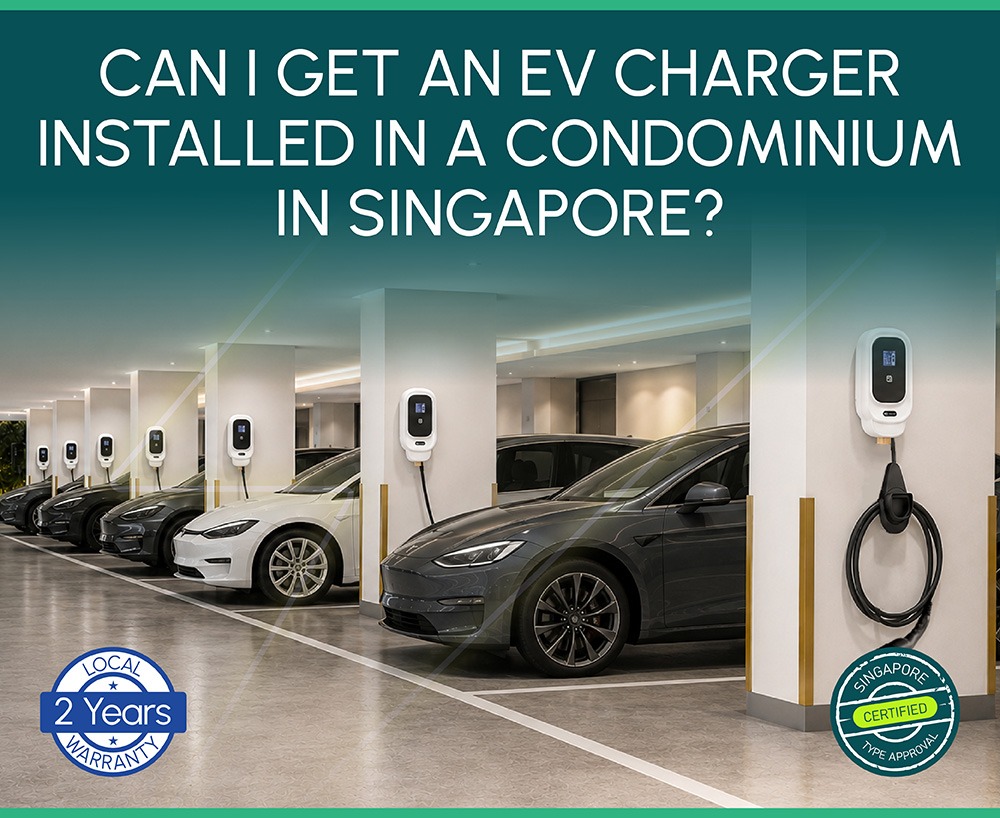
What are my options as a condo resident?
There are two common approaches for introducing EV charging in a condominium:
- Install a private charger
You can request a charger for your designated parking space, subject to the condominium’s approval and the technical feasibility of the installation.
This option gives you dedicated access to a charger for your vehicle. However, the installation may involve shared electrical infrastructure, common property and cable routes, so the proposed setup needs to be assessed before installation.
- Install shared condo charging
Instead of providing a charger for one resident, the condominium can also consider installing charging infrastructure for multiple residents to use.
This may be more suitable for developments where several residents already own EVs or where demand for EV charging is expected to increase.
A shared system allows the condominium to consider the number and location of chargers, available electrical capacity, load management and how charging costs will be allocated.
If you would like your condominium to consider shared EV charging, you can raise the proposal with your MCST or managing agent. Demonstrating that there is resident demand can help the management understand the need for charging facilities and consider whether a shared solution is suitable for the development.
How Do I Get Approval from the MCST?
Before arranging an EV charger installation, residents should speak with their MCST or managing agent to understand the development’s approval requirements.
Singapore has also introduced measures like the EV Common Charger Grant (ECCG) to make it easier for strata-titled developments to install EV chargers. For certain proposals, MCST approval can be obtained with a simple majority of votes at a general meeting, subject to the applicable conditions.
The exact approval process will depend on the proposed charging arrangement and the condominium’s circumstances.
When approaching the MCST, it is useful to provide enough information for them to understand whether the installation is practical. A site assessment by an EV charger installer can help establish key details such as:
- Proposed charger and location
- Available electrical capacity
- Power source and distribution board capacity
- Distance and cable route to the parking space
- Required electrical protection
- Metering and electricity usage arrangements
- Communication or network requirements, where applicable
- Who will carry out the installation
A professional site assessment can also identify any limitations with the existing electrical infrastructure and determine what work may be required.
This is particularly important if multiple chargers are being considered. Where several vehicles may charge at the same time, load management can help distribute the available electrical capacity between chargers.
The aim is to give the MCST a clear proposal and allow the appropriate professionals to assess what is feasible.
7kW vs 22kW EV Charger for a Condominium?
For many residential applications, a 7kW AC charger is one of the most practical options. Most vehicles parked at a condominium remain there for several hours, particularly overnight. In this situation, extremely fast charging is often unnecessary.
A 22kW AC charger can offer faster charging, but it is not automatically the right choice for every condominium. 22kW charger typically requires a suitable three-phase electrical supply and sufficient spare capacity. The vehicle must also support 22kW AC charging to charge at that rate.
Make Sure Your Charger and Installation Meet Singapore Requirements
Before proceeding with an EV charger installation, make sure both the charger and the electrical work meet Singapore’s applicable requirements.
The electrical installation should be carried out by a Licensed Electrical Worker (LEW) and include the appropriate protection, cable sizing, isolation and earthing. The completed installation must also undergo the required testing and commissioning before the charger is put into use.
The charger itself should have the relevant LTA type approval for use in Singapore. An overseas charger may carry international certification, but this does not automatically mean it is approved for local installation.
For residents, working with a local EV charging supplier and installer can help ensure that the charger selected and the installation carried out are suitable for use in Singapore.
How Do I Manage My EV Charger?
Once your EV charger is installed, how you use and manage it will depend on whether you have a private charger or use a shared condominium charging system.
- If you have a private charger
Depending on the charger, features such as app-based controls, scheduled charging and RFID access can allow you to control when the charger is used and monitor your charging sessions.
Electricity consumption can also be tracked through the charger’s monitoring functions or a separate metering arrangement, depending on how the installation is set up.
- If you use shared condo charging
Shared chargers need to accommodate multiple residents, so access and usage need to be managed accordingly.
Residents may use RFID cards, apps or other access controls to start a charging session, while some EV chargers with smart functions can record and monitor usage for billing or cost allocation. The exact arrangement will depend on how the condominium’s charging system is set up.
Why Choose NEG Power for Condominium EV Charger Installation?
At NEG Power, we do not see EV charger installation as simply supplying a piece of equipment. A good charging solution starts with understanding the property.
We help customers evaluate the electrical supply, determine the most suitable charging power, plan the installation and select an EV charger that fits the actual site conditions.
Our AC charger range includes 7kW and 22kW EV charging solutions for residential and commercial applications. For condominium projects, we can assist in assessing the technical requirements and developing a practical installation solution based on the available infrastructure.
Our goal is simple: provide an EV charging setup that is safe, practical and designed for reliable long-term use. You can learn more about our EV charging solutions at www.negpower.sg.
Frequently Asked Questions About Condo EV Charger Installation in Singapore
Can I install my own EV charger at my condo parking lot?
It may be possible, but you cannot simply install a charger without involving the condominium management. The MCST, parking arrangement, common property and electrical infrastructure need to be considered before installation.
Do I need MCST approval to install an EV charger?
For condominium installations, the MCST will normally need to be involved because the project may affect common property, electrical infrastructure or parking areas. The exact approval process depends on the proposed charging arrangement and the development.
Is a 7kW charger enough for a condominium?
For many residential users, yes. A 7kW AC charger is well suited to overnight charging because vehicles are normally parked for several hours. It also places less demand on the electrical system than a higher-powered charger.
Can I install a 22kW EV charger in my condo?
Possibly, but the property needs suitable three-phase electrical supply and sufficient capacity. Your EV must also support the relevant AC charging rate. A site assessment should be completed before deciding on a 22kW charger.
How is the electricity used by my EV charger calculated?
Depending on the installation, electricity consumption can be monitored through charging management functions or separate metering arrangements. Smart charging features can help track usage by individual users where required.