
_____
Electric Heavy Vehicle Charger Grant (EHVCG) Singapore 2026: Complete Guide
Contents
The Electric Heavy Vehicle Charger Grant (EHVCG) provides up to 50% co-funding for eligible electric heavy vehicle charger installation costs, capped at $30,000 per charger. The scheme runs from 1 January 2026 to 31 December 2028 and supports the first 500 chargers, subject to eligibility requirements.
This guide reflects LTA’s published EHVCG guidelines and Singapore’s EV charging requirements available as of September 2026.
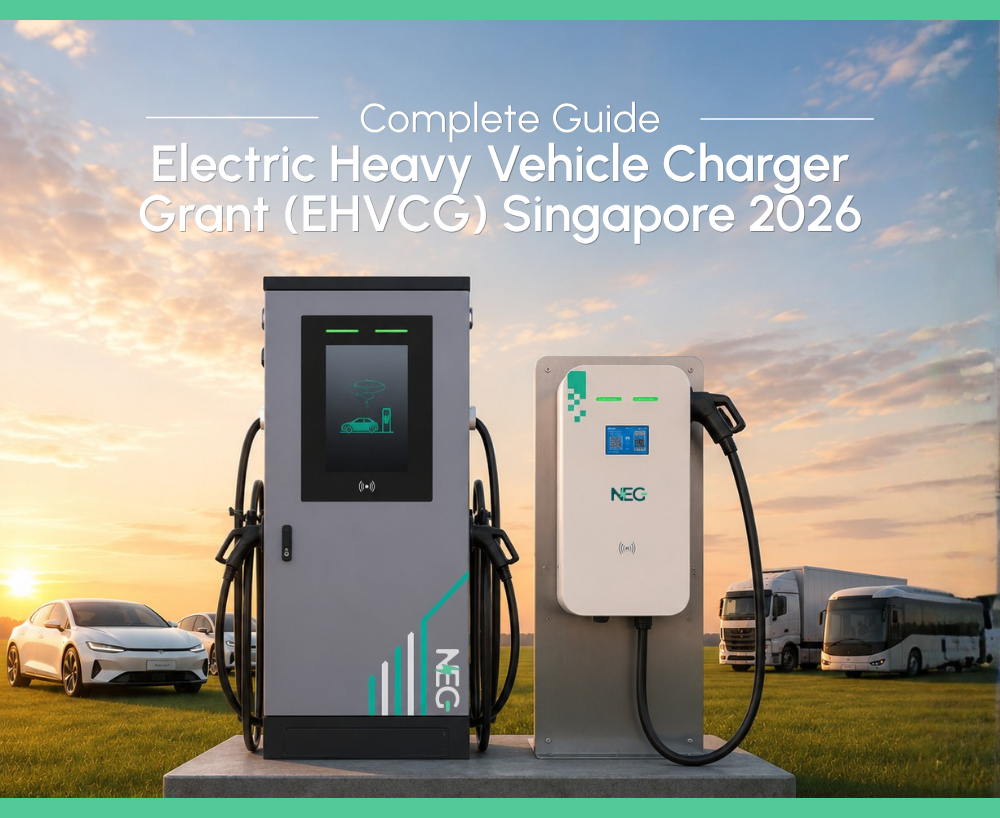
Why an Electric Heavy Vehicle Charger Grant (EHVCG)?
As Singapore moves towards the wider adoption of electric heavy vehicles (eHVs), switching from conventional heavy vehicles to electric ones requires more than replacing the vehicle itself. Operators also need suitable charging infrastructure at their depots, industrial sites and other operating locations.
To support this transition, the Land Transport Authority (LTA) introduced the Electric Heavy Vehicle Charger Grant (EHVCG) as part of Singapore’s efforts to encourage the adoption of electric heavy vehicles and develop the charging infrastructure needed to support them.
The grant is intended to help reduce the upfront cost of installing eligible chargers for businesses that are transitioning their heavy vehicle fleets to electric. This is particularly relevant for operators such as logistics companies, goods vehicle fleets, bus operators and other businesses that rely on heavy vehicles as part of their daily operations.
EHVCG therefore addresses an important part of fleet electrification: making sure businesses have the charging infrastructure needed to operate electric heavy vehicles in practice.
What costs does EHVCG cover? With Examples
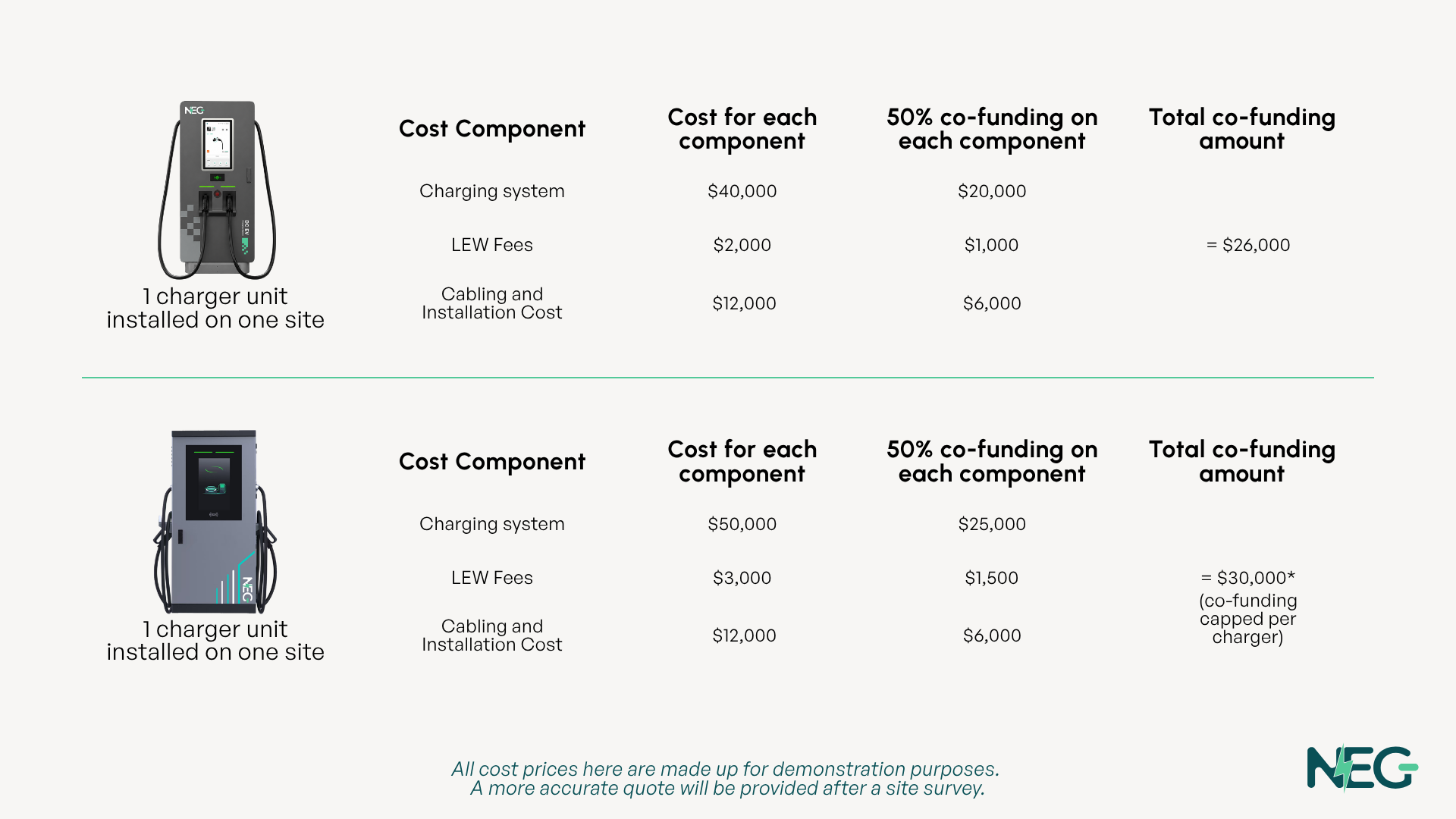
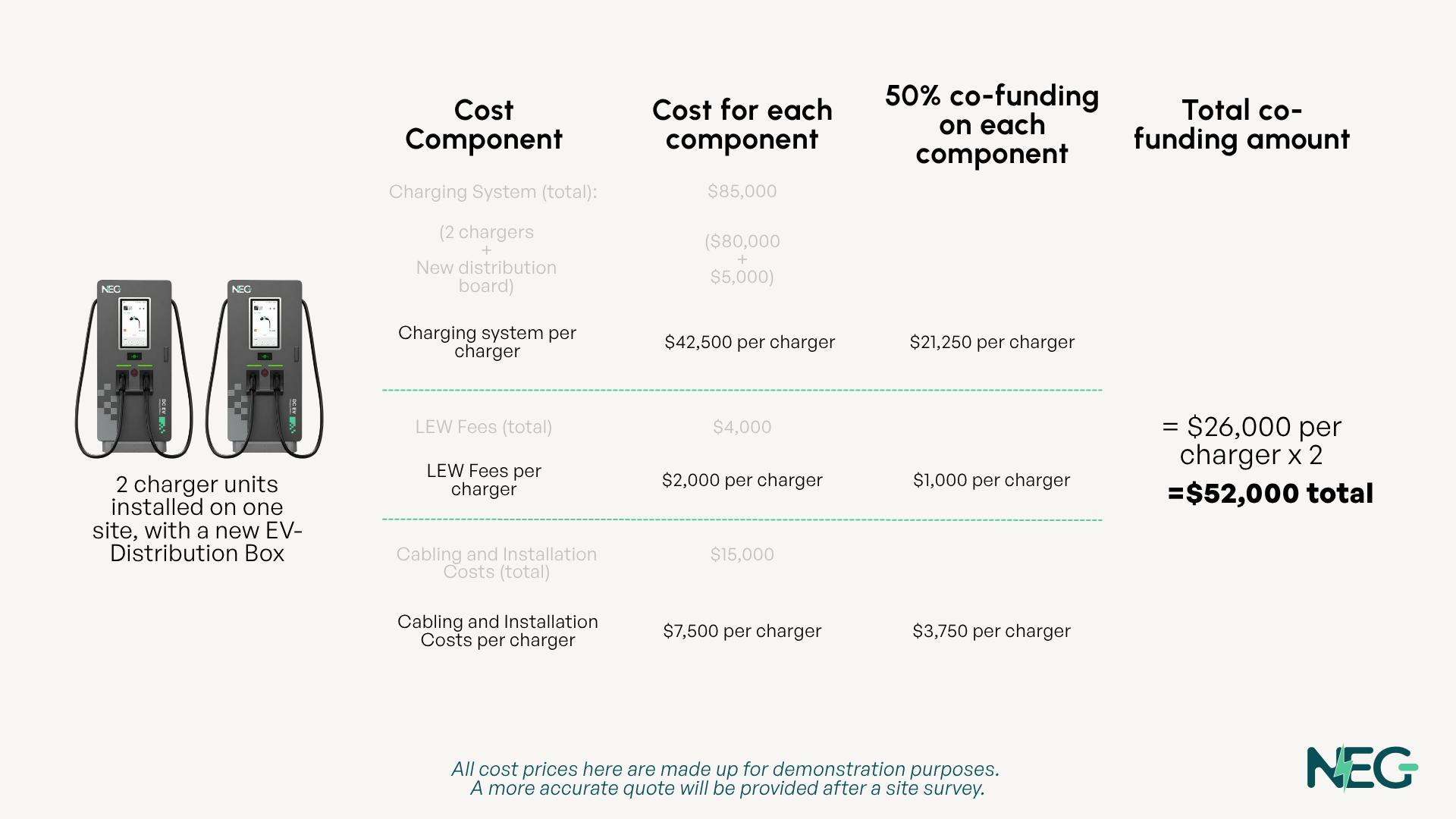
Each EHVCG application can include up to three chargers per site, with each charger eligible for up to $30,000 in co-funding.
For each charger, the EHVCG covers 50% of eligible costs across three cost components:
- Charger System (e.g. charger equipment and router)
- Licensed Electrical Worker (LEW) Fees
- Cabling and Installation Costs
This means an application covering three eligible chargers could receive up to $90,000 in total co-funding, subject to the eligibility and cost requirements set by LTA.
Eligibility and Requirements for EHVCG
Any business that registers a new electric heavy vehicle (eHV) between 1 January 2026 and 31 December 2028, can apply for the EHVCG. However, approval and co-funding are subject to LTA’s eligibility requirements, including requirements for the eHV, charger, installation site and supporting documentation.
There are 5 requirements for a charger to be eligible for co-funding:
- For each co-funded charger, a new electric heavy vehicle (eHV) must be registered together.One eligible eHV can support the co-funding of one charger. If you are applying for three chargers, you would generally need three qualifying new eHVs.
- A maximum of three chargers can be installed per siteEach application can include up to three co-funded chargers at the same site.However, this does not mean a company is limited to three chargers in total. Additional chargers may be eligible for co-funding if they are installed at another eligible site and the relevant requirements are met.
- Charger(s) must be installed at the applicant’s place of business, such as office, client site, or heavy vehicle parking lots.If installation site is not owned by applicant, a signed Letter of Confirmation between Applicant and Building Owner is needed.
- Charger(s) must meet the minimum power rating of 50kW and be considered a Smart Charger.A Smart Charger consists of the following functions:
- Able to receive and react to information received, such as by adjusting the rate of charging;
- Able to monitor and record energy consumption and timestamp of consumption, and be able to transmit it; and
- Makes use of Open Charge Point Protocol (version 1.6 or above) to transmit and receive information.
- Charger(s) must serve electric heavy vehicles, and hence installed at the appropriate charging lot.A minimum dimension of 7.5m x 3m for angled parking and 9.0m x 3.0m for parallel parking is required.
Do note that approved chargers that have received co-funding must be operational for at least three years from the issuance of the Letter of Offer.
How to apply for EHVCG: Step-by-step
The EHVCG application process can be broadly divided into three stages: preparing for the application, submitting the application and receiving approval, and completing the installation and claim.
Stage 1: Before Application
Before submitting an application, businesses should first confirm that their eHV, proposed charger and installation site meet the EHVCG requirements.
A professional site assessment can then help determine whether the proposed location is suitable for the charger, including considerations such as electrical capacity, charger placement and installation requirements. An experienced charger installer may also be able to advise on the technical and documentation requirements for the EHVCG application.
You should also prepare the required supporting documents, including:
- Information on building owner / proprietor
- Letter of Confirmation between Applicant and Building Owner (DOC, 39kB) (if applicable)
- Checklist A (XLSX, 47kB)
- Invoice / Quotations with EV charger installation cost
- Receipt/paid invoice for deposit for purchase of eHV OR purchase order for eHV
Stage 2: Application & Approval
Once the required information and documents are ready, applicants can submit their EHVCG application through the Business Grants Portal (BGP).
LTA will assess the application against the scheme’s eligibility and funding requirements. If the application is approved, the applicant will receive a Letter of Offer stating the approved grant quantum and relevant conditions. Based on our experience, it takes about 14 business days for you to know the outcome of your application.
Important: Applicants should wait for the Letter of Offer before proceeding with the charger installation. Costs incurred before the grant is approved may not be eligible for co-funding.
Stage 3: Installation & Claim
After receiving and accepting the Letter of Offer, the applicant can proceed with the approved charger installation.
Applicants are required to pay the installation costs upfront before subsequently submitting a claim to LTA. Supporting documents, such as invoices and receipts, will be required for the claim.
The charger must also remain operational for the required period stated under the EHVCG conditions.
The exact claim and disbursement requirements should be checked against the latest LTA EHVCG guidelines before proceeding.
EHVCG vs HVZES: What’s the difference?
Both the EHVCG and the Heavy Vehicle Zero Emissions Scheme (HVZES) are schemes to help support the electrification of fleets in Singapore. While EHVCG primarily focuses on the funding of the charging infrastructure, the HVZES is an incentive given to those who register eligible electric Heavy Vehicles (eHVs). These two schemes can work hand in hand to lower the costs of EV fleet ownership, reducing the hurdle for businesses and fleet owners to make the switch.
How EHVCG can support different fleet and business cases
Charging needs can look very different depending on how an electric heavy vehicle is used. Charging time depends on factors such as the charger’s power output, the vehicle’s charging capability, battery capacity and how much energy the vehicle needs between trips.
For businesses transitioning from ICE heavy vehicles to electric, they will need to consider if their charging setup fits into the fleet’s daily operations. EHVCG can help offset part of the upfront cost of putting this infrastructure in place.
Logistics and Delivery Operators
For logistics and delivery operators, vehicles may return to a depot between delivery runs and remain there for several hours before their next trip. Installing chargers at the depot allows vehicles to recharge during planned downtime rather than relying entirely on public charging infrastructure.
Commercial Fleet Operators
For businesses operating eHVs as part of their day-to-day operations, such as construction, waste management, transport or other commercial services, they may have vehicles following less predictable schedules.
A dedicated charger at the company’s operating site can provide greater control over when and where vehicles are charged. Depending on the operation, smart charging capabilities can also help businesses manage charging around vehicle schedules and available power.
Multi-site operations
There are also businesses with vehicles operating across different locations, which may need charging infrastructure at more than one site.
EHVCG allows eligible businesses to apply for co-funding for up to three chargers per site, subject to the scheme’s eligibility requirements. Where a business operates across multiple eligible locations, charging infrastructure can therefore be planned around where its eHVs are actually based or operated.
Real-world EHVCG charger installation examples
How NEG Power can help
Applying for EHVCG is only one part of putting an electric heavy vehicle charger into operation. The charger, electrical infrastructure, installation site and vehicle requirements all need to work together for a smooth transition towards fleet electrification.
As a Singapore-based EV charging company, we support businesses through this process with local knowledge of EV charging requirements and the practical considerations involved in deploying chargers in Singapore.
We help businesses with:
- Charger selection—identifying suitable DC charging solutions based on vehicle requirements and operating schedules.
- Site assessment—assessing the proposed installation site and its electrical and physical requirements.
- EHVCG guidance—helping businesses understand the information and supporting documents required for their application.
- Installation and commissioning—coordinating the installation and bringing the charger into operation.
- Local support—providing a local point of contact for product, installation and after-sales support.
With our focus on tailoring charging solutions for every business’s operations, we help them manage costs, minimise downtime and get more value from their electric fleet.
EHVCG Frequently Asked Questions
How much funding can I receive under EHVCG?
EHVCG provides 50% co-funding of eligible costs, capped at $30,000 per charger. Up to three chargers can be included per site, subject to eligibility requirements.
Is EHVCG still available in 2026?
Yes. EHVCG runs from 1 January 2026 to 31 December 2028 and supports the first 500 eligible chargers, subject to the scheme’s requirements.
Can EHVCG cover cabling and installation costs?
Yes. Eligible costs can include the charger system, LEW fees, and cabling and installation, subject to LTA’s requirements and the $30,000-per-charger cap.
Do I need to own the site where the charger is installed?
No. If the site is not owned by the applicant, a Letter of Confirmation between the applicant and building owner is required.
Can I install the charger before my EHVCG application is approved?
Businesses should wait for the Letter of Offer before installing the charger. Costs incurred before approval may not be eligible for co-funding.
Do I have to pay for the charger and installation upfront?
Yes. Applicants pay the costs upfront and subsequently submit a claim to LTA for the approved co-funding.
Does SS 722 affect my EHVCG application?
SS 722 replaced TR25 as Singapore’s national EV charging standard from 1 April 2026. However, LTA has provided a transition period for new chargers, while chargers already type-approved under the earlier TR25 standards do not need to be re-certified solely because of the change. For an EHVCG application, businesses should ensure that the proposed charger meets the current applicable LTA requirements for approval and installation.